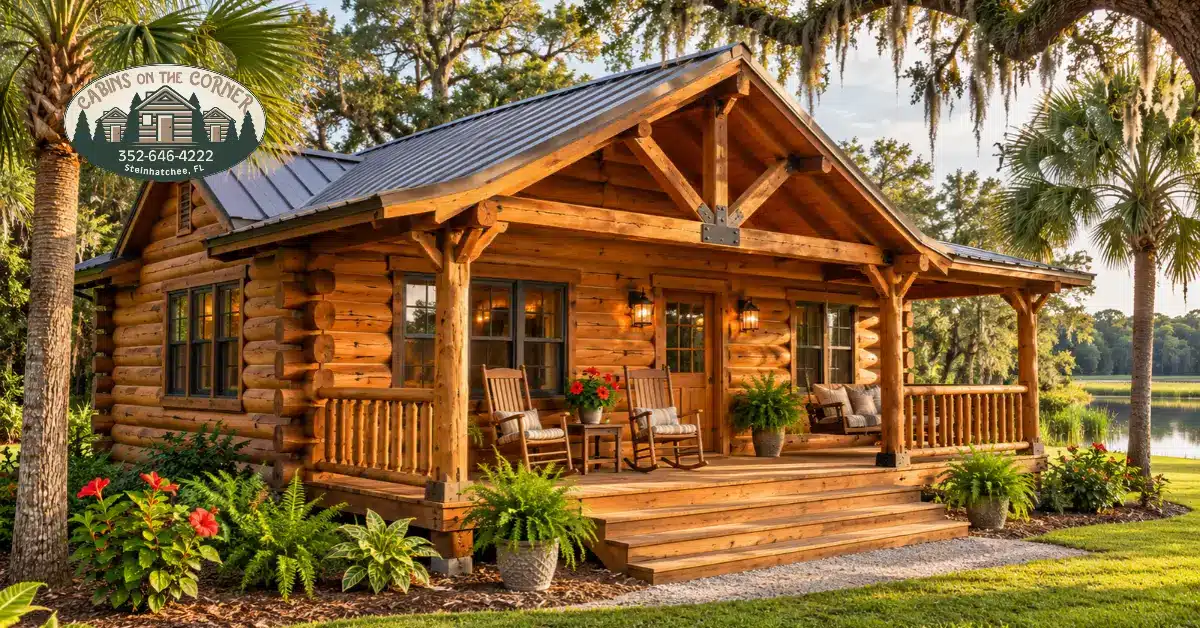
Amish-built log cabins are handcrafted in a workshop by Amish or Amish-rooted builders and then delivered to the property. All three rental cabins at Cabins On The Corner in Steinhatchee were built by Lancaster Cabins, a Lancaster County, Pennsylvania company with Amish roots, so guests sleep inside real pine log walls, not log-look siding.
That builder distinction matters when you book. Any property can call its cabins “Amish-built.” Only a named builder with a publicly available project record can substantiate the claim. Here, the builder is on record, the project page is live, and the material specs are documented. Browse all three log cabins at Cabins On The Corner, then call (352) 646-4222 to check availability.
TL;DR
- Amish-built: The term describes who built a cabin and how, so the builder’s name is the detail worth checking.
- The builder is on record: Lancaster Cabins shows this property and its three cabins on its Steinhatchee project page.
- Real log walls: Kiln-dried pine logs are joined with tongue-and-groove edges and fastened with 8-inch log screws.
- Built for weather: Floor insulation, a metal roof, double-pane windows, and HVAC go in before the cabin ships.
- Three cabins: The Fisherman’s Cabin and Hunter’s Cabin sleep four; the Gator Hut sleeps three. Rates start at $109 a night.
- Best fit: The cabins suit anglers, hunters, winter visitors, and dog owners who want a handcrafted log cabin rental near the Steinhatchee River.
What Does “Amish-Built” Actually Mean for a Log Cabin?
“Amish-built” covers two different products, and the difference determines what a guest actually stays in. The label describes who built the cabin and how, not just a decorating style.
According to Zook Cabins, another Amish cabin builder, modular Amish-built cabins are constructed in sections at a production facility and placed on a basement or crawl-space foundation, similar to a standard house.
Solid-log park model cabins are built whole on a trailer frame and classed as park model RVs. Both types are associated with the same region. Lancaster County is home to one of the largest Amish communities in the country, and Amish-made cabins are sold throughout the county, as documented by Amish America.
The three cabins in Steinhatchee are the second type: real log park model cabins, crafted by hand in the builder’s shop and connected to water, sewer, and electric on site. That classification matters at booking because it affects financing, insurance, and site requirements.
Who Built the Log Cabins in Steinhatchee?
Lancaster Cabins of Gap, Pennsylvania, built all three cabins at Cabins On The Corner and published a project page identifying the property’s address. The company describes itself as based in the middle of Amish Country with Amish roots.
In October 2026, Lancaster Cabins’ Steinhatchee project page listed the three cabins at 1033 Hwy 51 NE, Steinhatchee, FL 32359. The project page shows the cabins inside and out, with the street address attached. Lancaster describes them as premium park model homes set among the pines, with covered porches and warm pine walls.
A named builder with a public project page is the strongest signal that the “Amish-built” label holds up. When a listing cannot name its builder and point to a live project record, there is no way to verify the claim. The four-point check in the next section gives you a fast way to evaluate any property.
How Amish Cabin Construction Works, Step by Step
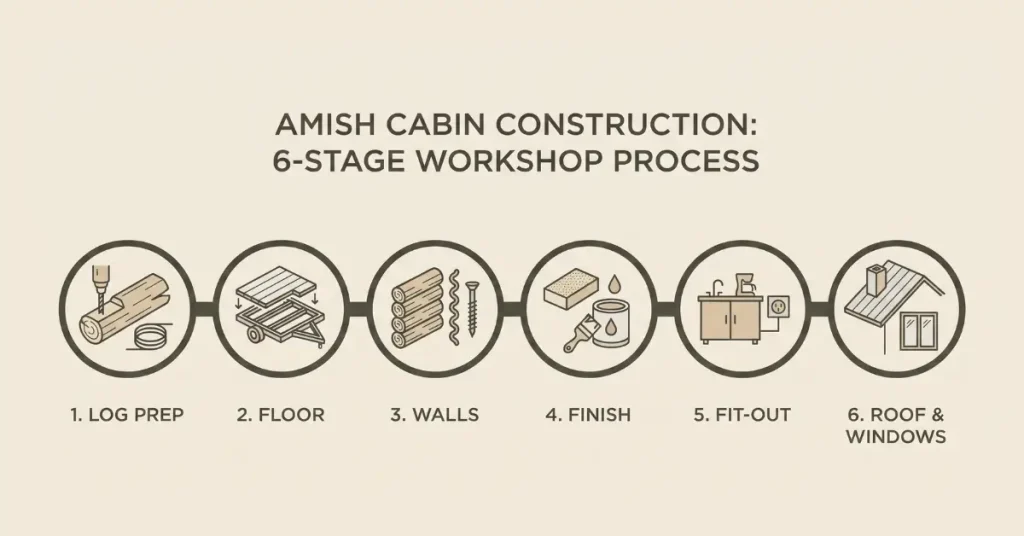
Lancaster Cabins builds each cabin from raw logs into a finished unit in 10 days, entirely inside the builder’s workshop before shipment. The build runs in six stages.
- Log prep: Rough pine timbers are kiln-dried, rounded, cut with a tongue and groove along each log, drilled for wiring, and notched at the corners.
- Floor: Joists go onto the trailer frame, followed by 2-by-6 tongue-and-groove floorboards with foam insulation underneath.
- Walls: The crew stacks the logs, lays foam weatherstripping between courses, runs wiring through the walls as they rise, and drives 8-inch log screws every few feet.
- Finish: Every surface is sanded and every corner caulked. The interior receives several coats of polyurethane, and the exterior receives a heavy coat of stain.
- Fit-out: Hickory cabinets, bathroom fixtures, electrical work, furniture, appliances, and the HVAC system go in.
- Roof and windows: A metal roof with a 40-year paint warranty goes on, and aluminum double-pane insulated windows close the shell before a final inspection.
What a guest sees from that process: sanded pine on the walls, hickory cabinets in the kitchen, and wiring hidden inside the logs. That is what separates a handcrafted park model from a log-look manufactured unit.
Real Log Walls vs. Log Siding: How to Check Before You Book
In a solid-log cabin, the stacked logs themselves form the walls. In a log-siding cabin, standard framing sits behind a thin log veneer that gives only the look of solid wood. Lancaster states that its cabins use real log timber for the walls, ceilings, doors, beams, floors, and cabinets.
The Four-Point Amish-Built Check below applies to any listing that calls its cabins Amish-built.
| Check | What to Look For | These Three Cabins |
| 1. Named builder | The listing names the company that built the cabin | Yes: Lancaster Cabins of Gap, PA |
| 2. Public build record | The builder shows the cabin in its own project gallery | Yes: Lancaster’s Steinhatchee project page |
| 3. Log walls, not siding | The builder states that the walls are solid log timber | Yes: real log timber walls, floors, ceiling, and doors |
| 4. Wood inside | Interior photos show log walls and wood ceilings | Yes: interior photos on the project page |
A listing that cannot pass checks 1 and 2 offers no way to confirm the claim. Use checks 3 and 4 as a secondary filter once the builder passes the first two.
Do Log Cabins Hold Up in Florida Heat and Humidity?
Yes, when the build protects the wood. Lancaster builds that protection before shipping: exterior stain, interior polyurethane, a metal roof, double-pane insulated windows, and a full HVAC system. Lancaster states that its solid-log timber cabins have historically lasted more than 50 years with minimal maintenance.
Florida’s heat and humidity accelerate wood movement and rot when a cabin ships without proper sealing. The exterior stain and interior polyurethane slow moisture entry. The metal roof handles the rain. The HVAC controls interior humidity year-round, which matters more in North Florida summers than in most of the country. Every cabin on this property has heating and air conditioning.
Guests who stay during the summer report that the cabins remain cool with the air conditioning running. The covered porches extend the usable outdoor space even in afternoon heat. Florida’s Big Bend coast can also bring tropical storm wind and rain; the metal roofs and sealed log walls are why these cabins handle those conditions without the maintenance concerns that wood-siding cabins carry.
Which Amish-Built Cabin Fits Your Trip?
The Fisherman’s Cabin and Hunter’s Cabin suit groups of up to four and longer stays; the Gator Hut sleeps up to three and suits couples or smaller families. See the full comparison of the three units, their sleeping capacity, kitchen setup, and rate details, then check activities and amenities for what each stay includes.
| Cabin | Sleeps | Beds | Kitchen | Monthly Rate | Best For |
| Fisherman’s Cabin | 4 | Queen + bunk beds | Full kitchen | $1,200/month | Anglers, longer stays, groups of 4 |
| Hunter’s Cabin | 4 | Queen + bunk beds | Full kitchen | $1,200/month | Hunters, longer stays, groups of 4 |
| Gator Hut | 3 | Queen + bunk over | Kitchenette | Monthly not offered | Couples, short weekends |
All three cabins include a private bathroom with shower, linens and towels, a smart TV, and free Wi-Fi. Shared access covers the grill, fire pit, and laundry. Rates start at $109 per night, with a two-night minimum and an additional $75 cleaning fee. The Fisherman’s Cabin has a spacious front porch for sorting gear. The Hunter’s Cabin matches its size with hunting-themed interiors. The Gator Hut suits a couple or a small family on a shorter stay. Hosts Beth and Jeff Morrill greet arrivals with homemade baked goods.
Why a Handcrafted Log Cabin Works for Fishing, Hunting, and Winter Trips
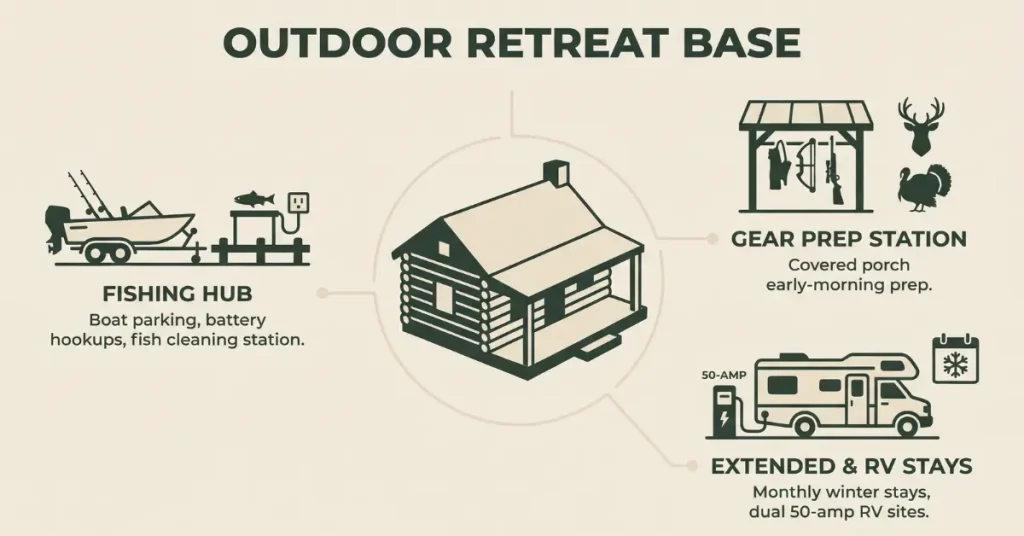
A log cabin with a kitchen, a covered porch, and on-site boat parking provides a convenient home base for fishing, hunting, or winter trips. The Steinhatchee Boat Ramp is 5 minutes away; the Jena/Dixie County Boat Ramp is 10 minutes away.
- Anglers: On-site boat parking, a fish cleaning house, and an electric hookup for battery charging make an early-morning departure easy. Read the fishing cabin amenities details, then check best fishing spots in Steinhatchee for spring and fall trout, redfish, and grouper runs. Scallop season in Steinhatchee runs from mid-June through Labor Day.
- Winter stays: The Fisherman’s Cabin and Hunter’s Cabin take monthly bookings at $1,200. The Christmas Boat Parade takes place each December. See the full Fiddler Crab Festival guide for the February Presidents’ Day weekend event that brings the biggest seasonal crowds.
- Hunters: The covered porch at the Hunter’s Cabin gives hunters a space for gear prep before early departures during deer and turkey season.
- Dog owners: The property is fully fenced and gated, and each cabin allows one dog for a $50 fee. Read the pet-friendly cabin tips for leash rules, the fenced perimeter, and what to bring.
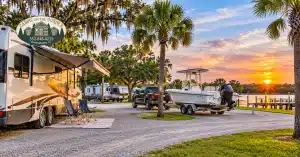
- Traveling with a camper instead? The property also has two 50-amp full-hookup RV sites, allowing groups to combine an RV stay with a cabin reservation at the same address.
Amish-Built Log Cabin FAQs
Are Amish-Built Cabins Better Than Regular Log Cabins?
Builders such as Zook Cabins state that Amish-built log cabins are built to better standards and last longer than manufactured log cabins. Quality still depends on the individual builder, so use the four-point check above before booking. A named builder, a public project gallery, documented solid-log walls, and visible wood interiors are the four signs that the Amish-built label is accurate rather than a marketing phrase with nothing behind it.
Are Amish-Built Log Cabins Considered Mobile Homes?
That depends on the builder. Some Amish-built cabins are modular homes placed on a permanent foundation. Others, including the cabins in Steinhatchee, are solid-log park model cabins built on a trailer frame and classed as park model RVs. That classification affects how the cabin is financed, insured, and sited. Ask the builder for the HUD label or park model certificate if the classification matters for your use.
How Long Do Amish Log Cabins Last?
Lancaster Cabins states that its solid log timber cabins historically last more than 50 years with minimal maintenance. The exterior stain, interior polyurethane, metal roof, and double-pane windows are part of the build to protect that lifespan. In Florida’s humidity, consistent HVAC use and annual exterior stain inspection are the two maintenance habits that preserve the wood over decades.
What Wood Are Amish Log Cabins Made From?
The Steinhatchee cabins are made from kiln-dried pine logs, cut with a tongue-and-groove joint, sealed with polyurethane inside, and stained outside. Kiln drying removes moisture from the timber before construction, which reduces shrinkage, checking, and warping after the cabin is set. The tongue-and-groove cut along each log course creates a tight fit that limits air and water infiltration between courses.
Where Can I Rent an Amish-Built Log Cabin Near Me in North Florida?
Steinhatchee, a Taylor County town in Florida’s Big Bend region, has three Amish-built log cabins for rent at 1033 Hwy 51 NE, Steinhatchee, FL 32359. The property sits 1.7 miles from downtown Steinhatchee on the Gulf side of Taylor County. From Tallahassee, the drive is about 1 hour 20 minutes. From Tampa, allow roughly 2.5 hours. Call (352) 646-4222 to check availability before planning your trip.
Are Dogs Allowed in All Three Cabins?
Yes. Each cabin allows one dog for a $50 pet fee. Dogs must be leashed outside the cabin, and the entire property is fenced and gated. The fenced perimeter keeps pets on-site and away from the road. Confirm your dog’s size and breed when you call, since hosts may have specific rules. Bring food, bowls, and a leash; the fire pit and picnic area are shared outdoor spaces where leash rules apply.
Is There Boat Parking at the Cabins?
Yes. The property offers on-site boat parking, with two public boat ramps 5 and 10 minutes away. A December 2023 Hipcamp guest review noted boat parking with an electric hookup for charging batteries and a water hookup for flushing the motor, away from overhanging trees. Confirm the parking spot for your trailer length and rig size when you call, since longer trailers need a confirmed space before you arrive.
How to Book an Amish-Built Log Cabin in Steinhatchee
Book by phone, by email, or through the availability form. Hosts Beth and Jeff Morrill handle each reservation personally. Cabin stays require a two-night minimum and a 50% non-refundable deposit at booking, with the remaining balance due at check-in. Full cancellation terms sit on the pricing and policies page.
Check-in is at 3:00 p.m. and check-out is at 11:00 a.m., with early or late times available on request. Pick a cabin from the table above, then check availability for open dates, or call (352) 646-4222 and ask about current rates, pet rules, and boat parking for your dates.
Scallop season weeks, the February Fiddler Crab Festival, and December holiday dates fill the fastest. If your target dates are within four months of peak season, call as soon as your dates are set. Monthly winter bookings at the Fisherman’s Cabin or Hunter’s Cabin also require early planning, since the two units cover the same monthly rate and both draw snowbird interest from late fall onward.